How to Play Texas Hold'em: Rules for Beginners
A plain-English guide to Texas Hold'em rules: the blinds and button, the four betting rounds, a worked example hand, showdown and tips for your first game.
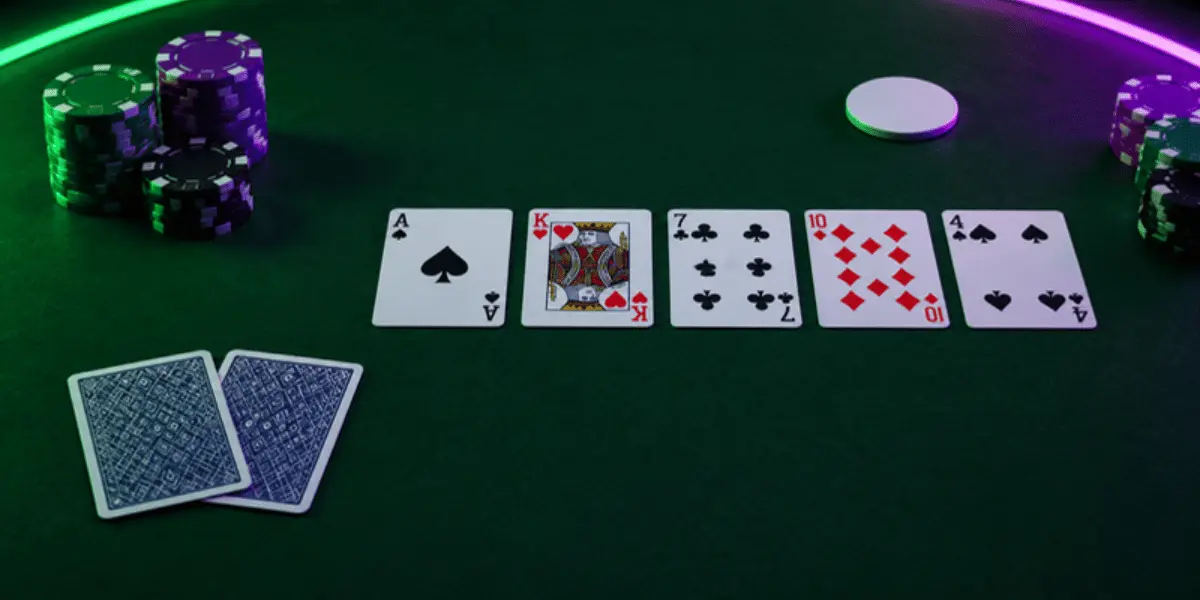
To play Texas Hold'em, each player is dealt two private hole cards and five community cards are dealt face up in the middle of the table. You make the best five-card poker hand from those seven cards, across four rounds of betting: pre-flop, flop, turn and river. You win the pot either by showing the best hand at showdown or by betting so that every other player folds.
The basics before you sit down
Hold'em uses a standard 52-card deck and is usually played by two to ten players per table. Hands are ranked in the same way as in most poker games, from a royal flush down to high card. If you do not know the order yet, read our poker hand rankings guide first, because every decision depends on it.
The button and the blinds
A round disc called the dealer button marks the nominal dealer. It moves one seat clockwise after every hand, so everyone takes a turn in each seat. Before any cards are dealt, the two players to the left of the button post forced bets called blinds.
- Small blind: posted by the player immediately left of the button. In a £1/£2 game this is £1.
- Big blind: posted by the next player to the left. In a £1/£2 game this is £2.
The blinds make sure there is always something in the pot to play for. When only two players are dealt in, the button posts the small blind and acts first before the flop. Where you sit relative to the button matters a great deal, as explained in our guide to poker positions.
The four betting rounds
| Round | Cards dealt | Who acts first |
|---|---|---|
| Pre-flop | Two hole cards to each player, face down | The player to the left of the big blind |
| Flop | Three community cards, face up | The first active player to the left of the button |
| Turn | A fourth community card | The first active player to the left of the button |
| River | A fifth and final community card | The first active player to the left of the button |
Action always moves clockwise. A betting round ends when every player still in the hand has put in the same amount, or is all-in, or when all but one have folded.
The actions: check, bet, call, raise and fold
- Check: pass the action to the next player without betting. You can only check if nobody has bet in the current round.
- Bet: put the first chips into the pot in a round.
- Call: match the current bet to stay in the hand.
- Raise: increase the current bet. Other players must then call the new amount, raise again or fold.
- Fold: throw your cards away and give up any claim to the pot. It costs nothing more.
In no-limit games the minimum bet is the size of the big blind, and a raise must be at least as large as the previous bet or raise. If someone bets £4, the smallest raise is £4 more, to £8 in total. You can only bet the chips you have on the table. If you run out you are all-in, and you can win only the part of the pot you have matched.
A worked example hand
Six players sit at a £1/£2 no-limit cash table. You are on the button with A♥ Q♥.
- Pre-flop: the blinds post £1 and £2. The first two players fold and the player to your right raises to £6. You call £6. The small blind folds and the big blind adds £4 to call. The pot is £19.
- Flop (Q♠ 8♥ 3♦): you have a pair of queens with an ace kicker. The big blind checks, the raiser bets £10, you call and the big blind folds. The pot is £39.
- Turn (5♥): your opponent checks. You bet £20 and they call. The pot is £79.
- River (2♣): your opponent checks and you check as well, which ends the betting.
- Showdown: your opponent shows J♠ J♣ for a pair of jacks. Your pair of queens wins the £79 pot.
Online, the room usually keeps a small fee from pots like this, known as rake. Our guide to poker rake and rakeback shows how it works.
Showdown rules
If two or more players remain after the river betting, the hands are turned over. The last player to bet or raise on the river shows first. If everyone checked, the first active player to the left of the button shows first. A player who sees they are beaten can usually discard their hand face down, which is called mucking.
You may use both of your hole cards, one of them or neither. If the five community cards are your best hand, you are playing the board. The cards decide the winner, not what a player announces, and identical hands split the pot equally. Suits are never used to break a tie.
No-limit, pot-limit and fixed-limit
- No-limit: you can bet any amount from the minimum up to all of your chips at any time. This is the most widely played form of Hold'em.
- Pot-limit: the largest raise allowed is the size of the pot after you have called. If the pot is £10 and an opponent bets £5, you can call £5 and raise by £20, making £25 in total.
- Fixed-limit: bets and raises come in set amounts. In a £2/£4 game they are £2 before and on the flop and £4 on the turn and river, usually with a cap on the number of raises in each round.
Cash games vs tournaments
In a cash game the chips represent real money, the blinds stay the same, and you can join, top up or leave whenever you like. Sensible limits on what you bring to the table are covered in our guide to poker bankroll management.
In a tournament everyone pays a fixed buy-in and receives the same number of tournament chips, which have no cash value. The blinds rise at set intervals, you play until you run out of chips, and the prize pool is shared among the top finishers. The most you can lose is your buy-in, but you may play for hours and win nothing.
Tips for your first game
- Fold most of your hands. Playing too many weak hands is the most common beginner error.
- Watch the button. Play fewer hands from early seats and more when you act last.
- Read the board carefully. Check whether the community cards make a straight or a flush possible before you put more chips in.
- Do not call just to see what happens. If you would not bet the hand yourself, folding is often right.
- Start small. Use play-money tables or the lowest stakes while you learn the flow of the game.
- Take your time. Online tables give you a clock for each decision, so use it.
Where to practise
When you feel ready to try a few hands, our comparison of the best UK poker sites sets out the options for new players.
Play responsibly
Poker is for adults aged 18+ only. Learning the rules does not guarantee wins, and short-term results depend heavily on luck. Set a budget you can afford to lose before you play, never chase losses, and visit BeGambleAware.org for free, confidential support.
Frequently asked questions
How many cards are you dealt in Texas Hold'em?
Each player gets two private hole cards. Five community cards are then dealt face up for everyone to share, and you make the best five-card hand from the seven.
Who bets first in Texas Hold'em?
Before the flop, the player to the left of the big blind acts first. On the flop, turn and river, the first active player to the left of the button starts the betting.
Do you have to use both hole cards in Hold'em?
No. You can use both, one or neither of your hole cards. Using only the five community cards is called playing the board.
What is the minimum raise in no-limit Hold'em?
A raise must be at least the size of the previous bet or raise. If a player bets £4, the smallest legal raise is to £8 in total.