Poker Positions Explained: Every Seat at the Table
Where you sit decides when you act. Learn the name of every seat at nine-handed and six-max tables, why the button is so valuable and how position shapes your range.
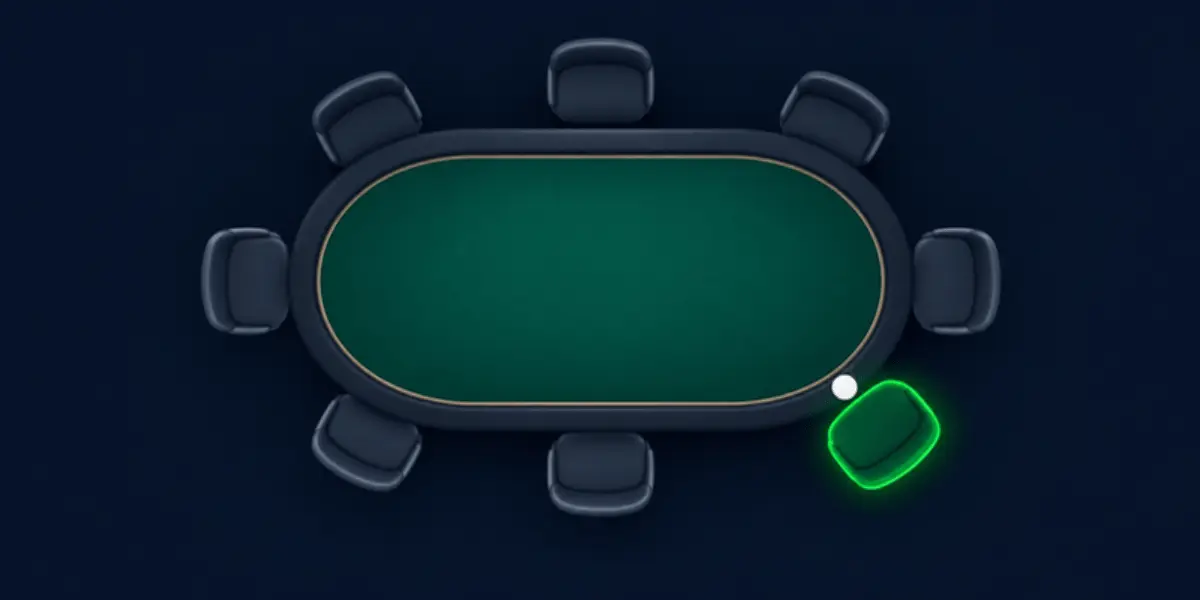
Poker positions describe where you sit relative to the dealer button, which sets the order in which players act. At a nine-handed table the seats are under the gun (UTG), UTG+1, middle position (MP), lojack (LJ), hijack (HJ), cutoff (CO), button (BTN), small blind (SB) and big blind (BB). The later you act, the more you know before you decide, which is why the button is the best seat at the table.
Every seat at a nine-handed table
Positions are not fixed chairs. The button moves one seat clockwise after every hand, so you pass through every position once per lap of the table. If the blinds and the button are new to you, start with our guide on how to play Texas Hold'em. The table below shows the order of action before the flop.
| Position | Short name | Group | Acts pre-flop | At six-max |
|---|---|---|---|---|
| Under the gun | UTG | Early | 1st | Seat removed |
| Under the gun plus one | UTG+1 | Early | 2nd | Seat removed |
| Middle position | MP | Middle | 3rd | Seat removed |
| Lojack | LJ | Middle | 4th | Yes, usually called UTG |
| Hijack | HJ | Middle to late | 5th | Yes, sometimes called MP |
| Cutoff | CO | Late | 6th | Yes |
| Button | BTN | Late | 7th | Yes |
| Small blind | SB | Blinds | 8th | Yes |
| Big blind | BB | Blinds | 9th | Yes |
After the flop the order changes. The small blind acts first, then the big blind, then the rest of the table in turn, finishing with the button. The button therefore acts last on the flop, turn and river.
Six-max poker positions
Six-handed tables, known as six-max, are very common online. Seats are named by counting backwards from the button, so a smaller table simply loses its earliest seats: UTG, UTG+1 and MP disappear. What remains is the lojack, the hijack, the cutoff, the button and the two blinds.
At six-max the first seat to act is usually just called UTG, even though it is the same seat as the lojack at a full table. That is a useful way to think about it. Opening from UTG at six-max leaves five players still to act, exactly as the lojack does nine-handed, so the two seats can play a similar range of hands.
Why acting last is an advantage
Being in position means you act after your opponent on each betting round after the flop. Being out of position means you act first. Poker is a game of incomplete information, and acting last gives you more of it.
- You see what others do first. A check often suggests weakness and a large bet often suggests strength. Out of position, you have to commit chips without that clue.
- You control the size of the pot. With a medium-strength hand you can check behind to keep the pot small, or bet when everyone has checked to you.
- You get cheaper cards. When you are drawing to a straight or flush, you can take a free card if it is checked to you. Our poker odds and outs guide shows how to value those draws.
- Your bluffs work more often. A bet after several checks has a better chance of taking the pot uncontested.
Position is also relative. If the button folds before the flop, the cutoff becomes the last player to act for the rest of the hand.
How opening ranges widen by position
An opening range is the set of hands you raise with when everyone before you has folded. Under the gun at a full table there are eight players still to act, and the chance that at least one of them holds a strong hand is high. On the button, only the two blinds remain. The same two cards can therefore be a fold in one seat and a raise in another.
As a rough guide rather than a fixed rule, many players open only around the top 10% to 15% of hands from under the gun at a nine-handed table, about 25% to 30% from the cutoff and 40% or more from the button. King-jack offsuit is a typical example. It is a fold under the gun, where it is easily dominated by hands such as ace-king or king-queen, but a standard raise from the cutoff or button. Small suited connectors such as 7♠ 6♠ follow the same pattern. Our Texas Hold'em starting hands guide groups hands by the seats they suit.
Late-position raises have a second purpose, often called stealing the blinds. If the players behind you fold, you win the £1 and £2 already in the pot without seeing a flop. In tournaments, where the blinds keep rising, this matters even more, as our poker tournament strategy guide explains.
Blind defence basics
The blinds are the hardest seats to play. You have put money in before seeing your cards, and after the flop you act first. Over time every player loses chips from these two seats on average, so the realistic aim is to lose less, not to win every pot you have paid into.
- The big blind gets a discount. In a £1/£2 game, suppose the button raises to £5 and the small blind folds. There is £8 in the pot and you need only £3 more to call. You are paying £3 into what will be an £11 pot, so you need to win about 27% of the time to break even.
- That price does not make every hand playable. Out of position you will not win your full share, so favour hands that connect with flops: pairs, suited cards, connected cards and decent aces. Fold weak offsuit hands such as jack-four or nine-three.
- Consider who raised. A button raise comes from a wide range, so you can defend more hands. An under-the-gun raise comes from a narrow, strong range, so defend fewer.
- Consider the size. The bigger the raise, the worse your price and the tighter you should be.
- The small blind is tougher still. You have less invested, the big blind can still raise behind you, and you will act first on every later round. Many players keep it simple by re-raising their strong hands and folding the rest.
Using position in practice
- Check where the button is before you look at your cards.
- Play fewer hands from early seats and more from the cutoff and button.
- Be cautious about calling raises when several players are still to act behind you.
- When you are out of position, keep pots smaller with marginal hands.
- Watch which opponents raise often from late position, since their ranges will be wider.
Where to practise
Low-stakes and play-money tables are a sensible place to get used to the seat names, and our comparison of the best UK poker sites can help you choose where to start.
Play responsibly
Poker is for adults aged 18+ only. Good positional play improves your decisions but cannot guarantee wins, and short-term results depend heavily on luck. Set a budget before you play, stick to it, and visit BeGambleAware.org if you need free, confidential support.
Frequently asked questions
What is the best position in poker?
The button. It acts last on the flop, turn and river, so the player there sees what everyone else does before deciding.
What does UTG mean in poker?
UTG stands for under the gun, the seat to the left of the big blind. It is the first to act before the flop, so it calls for the tightest range of hands.
What is the worst position at a poker table?
The small blind is generally the hardest seat, because you post a forced bet and then act first on every round after the flop. Under the gun is the toughest seat to open from.
What is the difference between the hijack and the cutoff?
The cutoff is the seat directly to the right of the button, and the hijack is one seat further to the right. The cutoff acts later, so it can open slightly more hands.