How to Play Omaha Poker: PLO Rules for Beginners
Four hole cards, pot-limit betting and one rule that trips up every Hold'em player. Here is how Pot-Limit Omaha works, with worked examples in pounds.
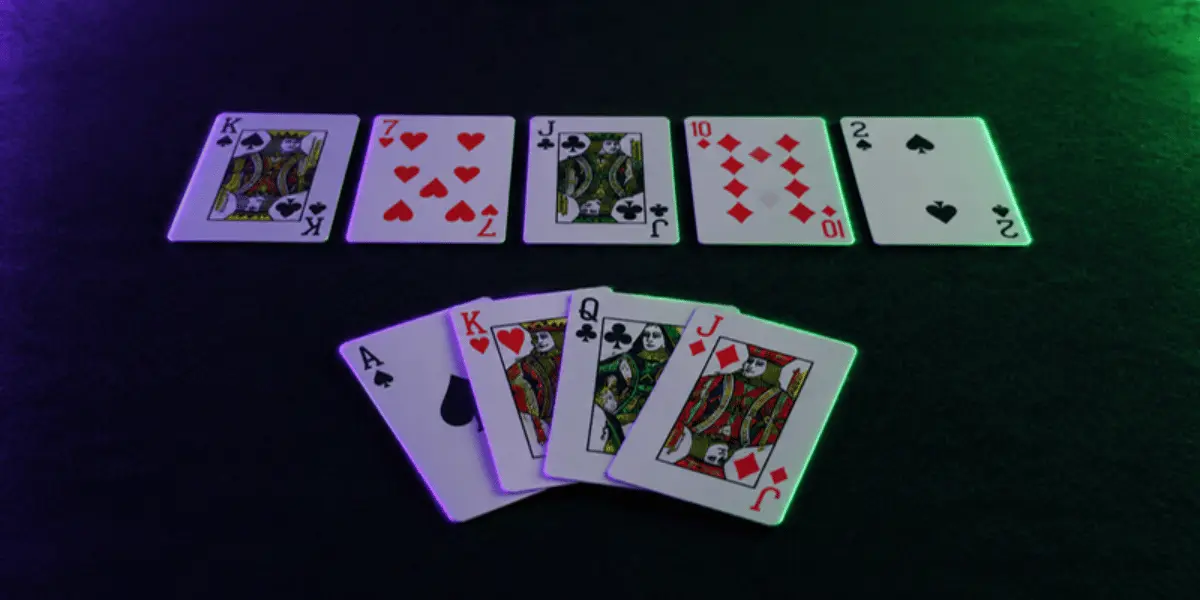
Omaha is played like Texas Hold'em with one big difference: each player is dealt four hole cards and must make a five-card hand using exactly two of them plus exactly three of the five community cards. It is usually played pot-limit (Pot-Limit Omaha, or PLO), which means the biggest bet you can make at any time is the size of the pot.
The basic rules of Omaha
If you already know how to play Texas Hold'em, the shape of an Omaha hand will feel familiar. There is a dealer button, a small blind and a big blind, and the action moves clockwise.
- Pre-flop: every player receives four private hole cards, followed by a round of betting.
- Flop: three community cards are dealt face up, followed by a betting round.
- Turn: a fourth community card and another betting round.
- River: the fifth and final community card and the last betting round.
- Showdown: the remaining players reveal their cards and the best five-card hand wins the pot.
Hands are ranked exactly as they are in Hold'em, from high card up to a royal flush, so the standard poker hand rankings apply.
The rule that catches everyone out: exactly two hole cards
In Hold'em you can use both, one or neither of your hole cards. In Omaha you must always use two cards from your hand and three from the board. Never one, never three. Most beginner mistakes come from forgetting this.
- The one-card flush. The board shows four spades and you hold the ace of spades with no other spade. In Hold'em that is the best possible flush. In Omaha you have no flush at all, because you need two spades in your hand.
- The straight on the board. The board runs 5-6-7-8-9 and you hold A-A-K-K. You do not have a straight. Your best hand is a pair of aces (A-A with 9-8-7). A player holding J-10 makes a jack-high straight.
- The phantom full house. The board is K-K-7-7-2 and you hold A-K-Q-J. In Hold'em you would have kings full of sevens. In Omaha your best hand is K-K-K-A-7, which is only three kings. You would need K-7 in your hand, or a pocket pair matching a board card such as 2-2, to make a full house.
- Too much of a good thing. Being dealt three aces or four hearts looks powerful but is not. Only two of those cards can ever play, and the extras are cards you can no longer hit on the board.
Pot-limit betting and the pot-sized raise
Most Omaha is played pot-limit. The minimum bet is the size of the big blind and the maximum is the size of the pot. If nobody has bet yet, that is simple: with £10 in the pot, you can bet up to £10.
Raising takes one extra step. The maximum raise is the size of the pot after you have called. Here is a worked example:
- The pot is £10 and your opponent bets £10, so there is £20 in the middle.
- You first call the £10, which makes the pot £30.
- You may then raise by up to £30 more.
- Your total bet is £40: the £10 call plus the £30 raise.
A handy shortcut is to multiply the last bet by three and add whatever was in the pot before that bet. Here, 3 × £10 + £10 = £40. The same sum works before the flop. With blinds of £1/£2 there is £3 in the pot, so a pot-sized raise from the first player to act is 3 × £2 + £1 = £7. Online, the software works it out for you when you press the pot button.
Why hand values run higher than in Hold'em
Four hole cards can be paired up in six different ways, so every player effectively holds six two-card Hold'em hands at once. With several players each holding six combinations, somebody very often makes a straight, flush or full house by the river.
That changes what counts as a good hand:
- One pair, and even two pair, seldom wins a large pot at showdown.
- Draw to the nuts (the best possible hand). A king-high flush is a strong hand in Hold'em; in Omaha it regularly loses to the ace-high flush.
- Once the board pairs, a full house is possible, and straights and flushes drop sharply in value.
- Draws are bigger. A "wrap" straight draw, where your hole cards surround the board cards, can have up to 20 outs, compared with eight for an open-ended draw in Hold'em. Our guide to poker odds and outs explains how to count them.
Starting hands are also much closer in strength than in Hold'em, so even premium hands are far from certain winners and the swings are larger.
Good and bad Omaha starting hands
The best Omaha hands have four cards that all work together. Look for these qualities:
- Double-suited: two cards of one suit and two of another, giving two possible flush draws. Ace-high suits are best because they make the nut flush.
- Connected: cards close in rank that can make straights in many ways.
- Rundowns: four cards in sequence, such as J-10-9-8 or 9-8-7-6, ideally suited or double-suited.
- High pairs with back-up: A-A-K-K double-suited is generally regarded as the strongest starting hand, and A-A-J-10 double-suited is close behind.
These are the warning signs:
- Danglers: a card that does not connect with the other three. In K-Q-J-4 the four is a dangler, and you are effectively playing a three-card hand against opponents with four.
- Three or four of a kind: hands such as 8-8-8-3 waste cards and are harder to improve.
- Rainbow, disconnected hands: something like K-9-5-2 in four different suits has no flush potential and little straight potential.
- Bare aces: A-A with two unrelated, unsuited cards is still playable, but it is far weaker than beginners assume once several players see the flop.
As in Hold'em, acting last gives you more information, so hands gain value on the button. See poker positions explained for more on this.
Omaha Hi-Lo in brief
Omaha Hi-Lo, also called Omaha 8-or-Better, splits each pot in two. Half goes to the best high hand and half to the best qualifying low hand. A low hand is five cards of different ranks, all eight or lower. Aces count as low, and straights and flushes are ignored for the low, so the best possible low is A-2-3-4-5.
The two-from-your-hand rule applies to both halves, although you can use different hole cards for the high and the low. If nobody can make a qualifying low, which needs three different cards of eight or lower on the board, the high hand takes the whole pot. The aim is to "scoop" both halves.
Omaha vs Texas Hold'em
| Feature | Omaha (PLO) | Texas Hold'em |
|---|---|---|
| Hole cards dealt | Four | Two |
| Hole cards used | Exactly two | Two, one or none |
| Community cards used | Exactly three | Three, four or five |
| Two-card combinations per player | Six | One |
| Usual betting structure | Pot-limit | No-limit |
| Typical winning hands | Straights, flushes, full houses | Often one or two pair |
| Starting hand strengths | Close together | Further apart |
| Swings (variance) | Generally larger | Generally smaller |
Tips for your first Omaha sessions
- Be selective. Four cards make every hand look playable. Most are not.
- Value the nuts. Second-best flushes and straights are the most expensive hands in Omaha.
- Read your hand twice. Check which two hole cards you are actually using before you put money in.
- Start small. Use the lowest stakes or play-money tables first, because the swings are bigger than in Hold'em.
Where to play
Most licensed UK poker rooms offer Pot-Limit Omaha cash games and tournaments alongside Hold'em, although the range of stakes varies. You can see what each room offers in our comparison of the best UK poker sites.
Play responsibly
Poker is for over-18s only. Short-term results depend heavily on luck, and no strategy guarantees a win. Set a budget you can afford to lose before you play, stick to it, and visit BeGambleAware.org for free advice and support if gambling stops being fun.
Frequently asked questions
What does PLO stand for?
PLO stands for Pot-Limit Omaha, the most popular form of Omaha. Each player gets four hole cards and the largest bet allowed at any point is the current size of the pot.
Can you use three of your hole cards in Omaha?
No. You must use exactly two of your four hole cards and exactly three community cards to make your five-card hand, every time.
Is Omaha harder than Texas Hold'em?
The rules are only slightly different, but there are more possible hands to think about and bigger draws, so many players find it harder to play well. Results also swing more from session to session.
What is the best starting hand in Omaha?
A-A-K-K double-suited is generally regarded as the strongest starting hand in Pot-Limit Omaha. Even so, it is a much smaller favourite before the flop than a pair of aces is in Hold'em.